

The AI Code Quality & Governance Platform for Enterprises
Qodo is the governance layer for your software factory. Standards, risk, and quality stay visible as agents ship faster than review was built to support.


Coding agents are moving faster than your ability to govern them
51.3%*
Larger PRs
441%*
Longer in review
54%*
More bugs
The review queue, under control
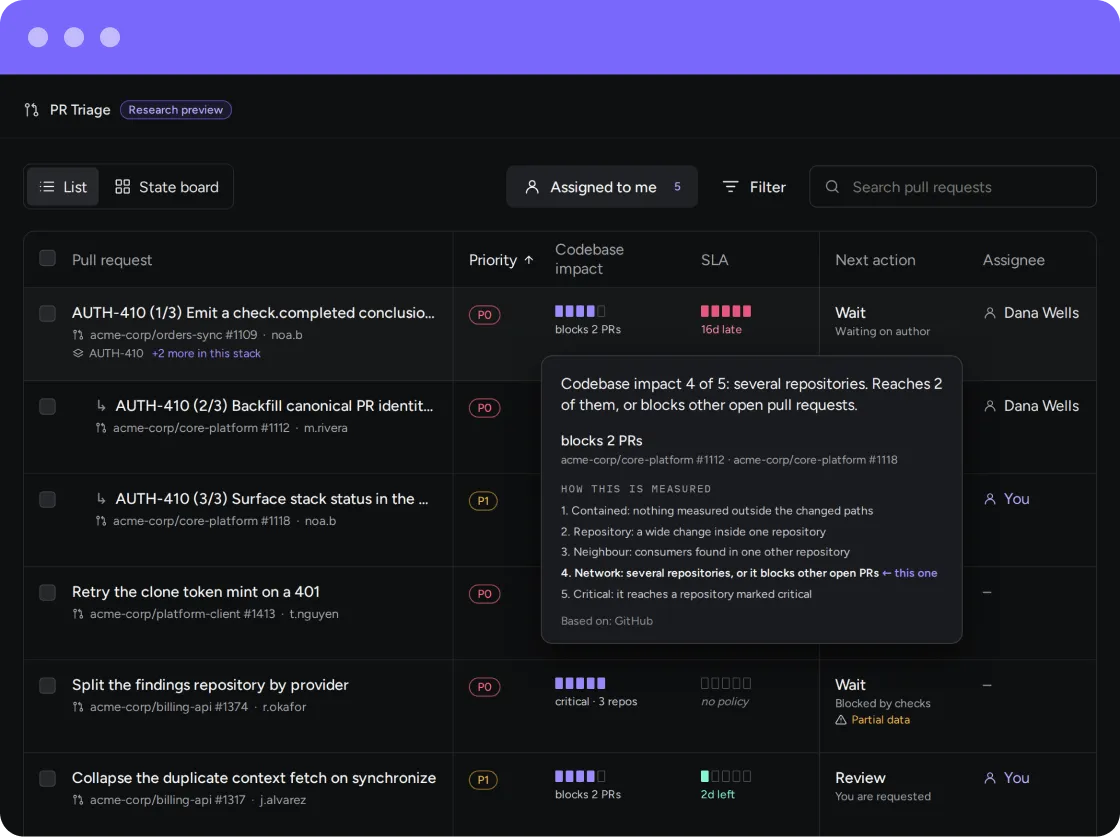
Agents open work packages across repos faster than any review process was built to support. Qodo brings every one of them into a single queue, with an owner on each.
- Claim a review. Ownership holds to one reviewer at a time, so the same work is reviewed once. Release a claim and the original clock picks up where it left off.
- See what is unclaimed and aging across the whole team, instead of one repo at a time.
- Drill into any PR for its findings, checks, cross-repo dependencies, and blast radius from the Software Map.
Risk, mapped across every repo
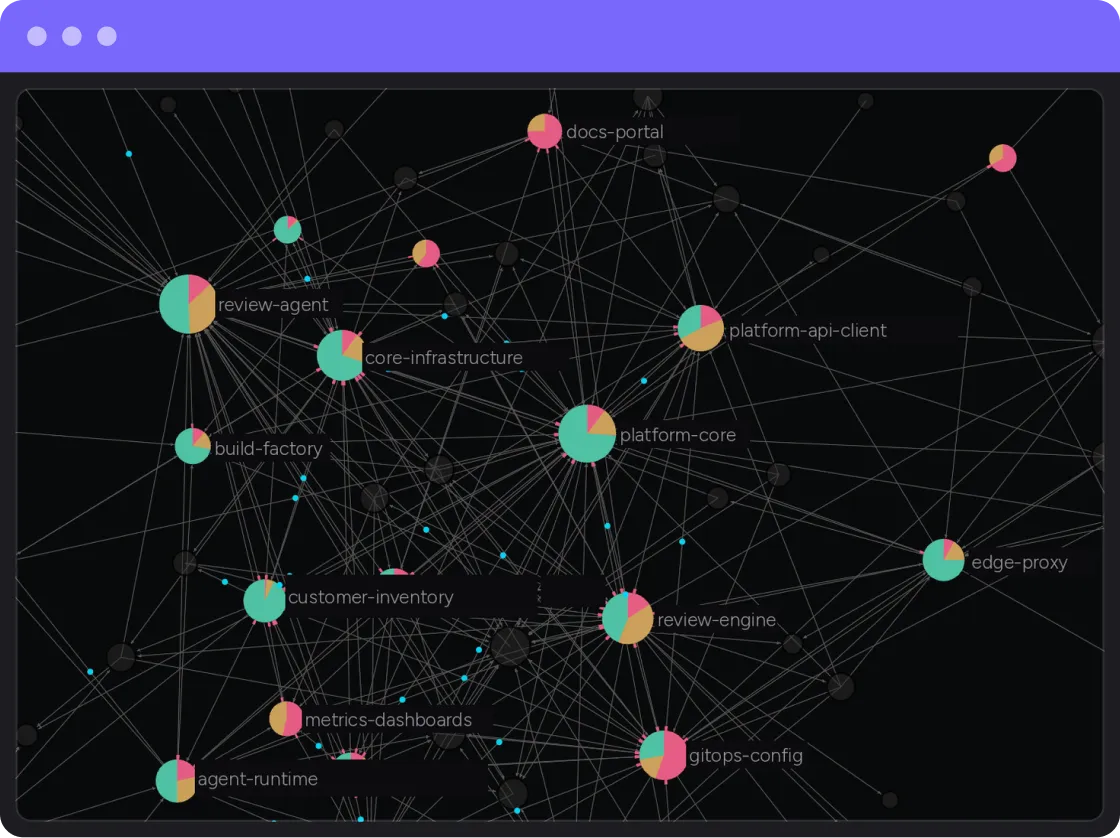
Qodo discovers your repos and their relationships automatically, across every git provider, and rebuilds the picture as each PR lands.
- See where findings concentrate across your software estate, with a heat map of where quality is slipping fastest.
- Spot the hubs and the supernova tier to see which repos are central, which are fragile, and where effort pays off next quarter.
- Trace the blast radius of a change before it lands, with cross-service contracts learned automatically.
Quality metrics, straight
from the review
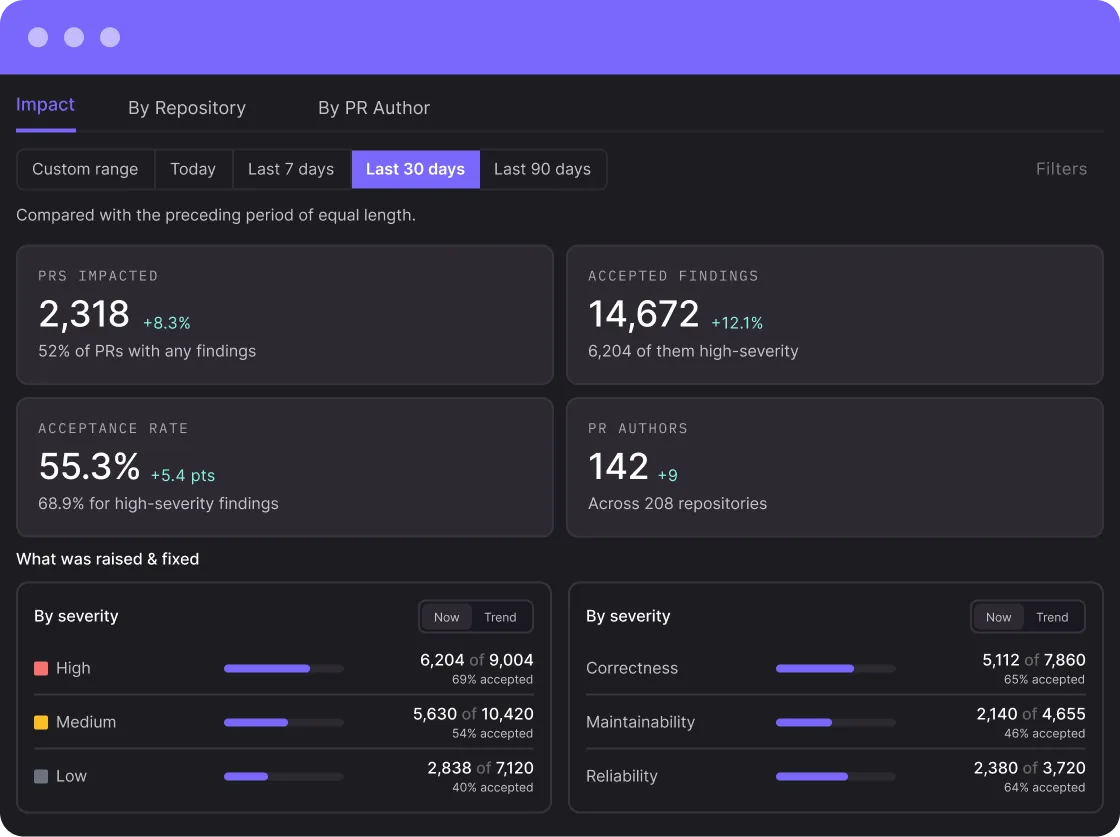
The numbers come from the platform doing the review, so there is nothing to instrument. Start at a top-line number and drill into the findings behind it.
- Acceptance rate by severity. How often developers act on what Qodo flags, and whether that holds on the highest-risk issues.
- PRs impacted. The share of PRs where a finding changed the code before merge, by repo.
- Issues caught before the PR. What developers catch in the IDE before a PR opens. PR-only review tools never see it.
Enterprise-Scale Codebase Intelligence
Holistic Understanding
of Complex Codebases
Builds a unified, continuously updated understanding of your architecture, services, dependencies, and patterns across repositories.
High-Fidelity Code
Retrieval at Scale
Delivers precise, context-aware insights across massive, distributed systems to support accurate reviews and enforcement.
Standards your team can
see and correct
Qodo learns what your team accepts and rejects, then applies those standards consistently across every team and repo. What is being enforced stays visible, so you can confirm it or change it.
Model-Agnostic, Enterprise-Ready AI
Powered by leading foundation models, with flexibility to align with your security, compliance, and deployment requirements.





What Qodo delivers to
engineering leaders

450K+ developer hours saved per year

Faster PR turnaround

Consistent quality across teams, languages, and repos

Automated compliance & standards enforcement

Governed, secure AI adoption for enterprise environments
Governance that
runs where your code runs


Full on-prem
and air-gapped
The Context Engine and the toolbox run inside your environment, so the codebase understanding stays inside your environment alongside the review.

Your key,
your gateway
Bring your own key and your own gateway. Open source model support including Nemotron, so review runs on models hosted in your own infrastructure.

SaaS and private cloud
Existing deployment options, unchanged.

Secure, private,
enterprise-ready
SOC2-ready, zero external data exposure.






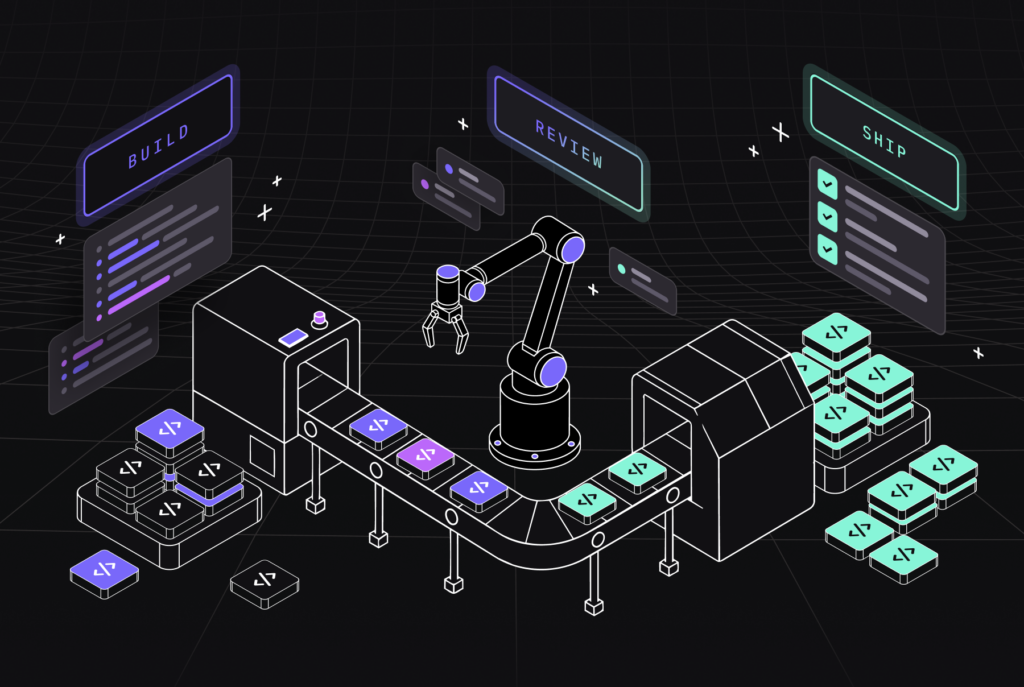
Learn more about Qodo from our blog
Explore our insights on enterprise AI engineering, code governance, and scaling quality across large, complex codebases.
Questions?
Qodo is an AI Code Quality and Governance Platform for enterprises running coding agents across the SDLC. Code review is where it starts and governance covers everything around it:
- Before code: your team’s rules, mined from PR history, are available to the coding agents that write the code.
- Pre-PR review: changes are reviewed in the IDE and inside coding agents through the Agentic Toolbox, before a PR is opened.
- In flight: agent PRs are grouped into work packages across repos, each with an owner and a review order.
- Impact: the Software Map shows what a change touches across repos.
- PR review: multiple specialized agents review each pull request with full codebase context from the Context Engine.
- Oversight: quality metrics give engineering leaders a number to report, with drill-down into the findings behind it.
Most enterprises piece this together from instruction files in every repo, linters that catch style but miss architecture, and dashboards built by hand. Qodo covers it in one governance layer across GitHub, GitLab, Bitbucket, Azure DevOps and Gerrit, in the cloud, on-prem or air-gapped.
AI code governance is how an engineering org keeps AI-generated code aligned with its standards before, during and after code review.
AI code review looks at a specific change and checks it for bugs, rule violations and risk. That change can be in the IDE, inside a coding agent before a PR is opened, or in the pull request itself. AI code governance covers everything around those changes: the standards agents write against, which work is in flight and who owns it, what each change touches across repos, and whether quality is improving over time.
Put simply, review answers “is this change ready to merge?” and governance answers “is our codebase getting better?” Qodo does both, with review at every stage and governance across the SDLC.
Yes. When an agent picks up a task, it often opens several PRs across different repos. PR Triage in Qodo groups those PRs into a single work package, so reviewers see one unit of work instead of a list of unrelated PRs.
For each work package, Qodo shows:
- which parts of the codebase it touches
- how hard it will be to review
- how long it has been waiting
- the order to review its PRs in, and which package unblocks the next feature
Reviewers can claim a work package, which marks it as taken for the rest of the team and for agents, so two people don’t review the same work twice. Teams can work through the queue as a ranked list or as a board. Tech leads can also generate a review brief for a work package and hand it to Claude Code, Codex or Qodo to review as one body of work.
Yes. The Software Map in Qodo shows how your system fits together across every repo. Qodo discovers your repos and builds the map automatically, then keeps it current on every PR, so there is nothing to configure.
The map shows which repos are central, which are hubs that everything routes through, the blast radius of each repo, and the service contracts a change puts at risk. You can scope it to a team or filter it to a service. Leaders use it to see where risk sits across the architecture, and developers use it to check what’s downstream before they change something. The Software Map builds on the same capability behind cross-repo review, so reviewers see what a change touches before review starts instead of after merge.
Yes. Rules in Qodo live in one portal, and the Agentic Toolbox makes them available to coding agents like Claude Code, Codex and Kiro while they write code. Agents work from your standards from the start, and the same rules are enforced again in the IDE and in PR review.
If your standards live in files like AGENTS.md, CLAUDE.md or .cursorrules today, Qodo imports them into the rules portal, so you manage one set of rules instead of separate copies in every repo. Admins can also manage skills (skills.md files) across repositories from the same portal.
Yes. Rule Miner analyzes your organization’s pull request history and turns recurring review feedback into rules. Only comments that developers accepted and fixed are counted, and feedback from reviewers who own the affected code carries more weight.
Every mined rule links back to the pull requests it came from, so you can see why the rule exists. Depending on your settings, new rules either go live automatically or wait in Suggestions until an admin approves them. When your team keeps dismissing what a rule flags, that rule’s signal drops over time.
With Qodo 3.0, PR History adds a view of past findings grouped by similarity and marked by how the team responded, from mostly accepted to mostly rejected. Findings the team keeps dismissing stop resurfacing, and findings that resemble past bugs are raised before the bug repeats.
The system that writes the code shouldn’t be the only system that reviews it. Built-in review checks code with the same tool that generated it. Qodo is an independent quality and governance layer that reviews every change against the same rules, whether it came from GitHub Copilot, Cursor, Claude Code, Codex or a developer.
Qodo also reviews with context beyond a single assistant session: the full codebase and related repos through the Context Engine, plus your team’s review history. Because every change goes through the same layer, engineering leaders get one view of quality across teams, repos and agents.
Qodo connects to Claude Code and Codex through the Agentic Toolbox, a plugin that gives the coding agent access to Qodo’s codebase knowledge, team rules and code review while it works. Developers keep working in Claude Code or Codex as usual, and the agent calls Qodo when a task needs it.
- Before writing: the agent checks dependencies and the potential impact of a change
- While writing: the agent applies your team’s rules
- Before the PR: the agent reviews its own changes and resolves findings
- After the PR: Qodo reviews the pull request, and a work package can be handed back to the agent as a single review brief
To set it up, install the Qodo plugin for Claude Code or Codex. The Agentic Toolbox is also available through CLI and MCP, and in Kiro. For background, see the Agentic Toolbox announcement and Qodo for Codex.
Qodo turns compliance and coding policies into rules that are enforced the same way at every stage, from the coding agent and the IDE to the pull request, in every repo, whether a developer or an agent wrote the code.
Rules can be scoped at the organization, repository group or repository level. Rule analytics track adoption and violations over time, so compliance teams can see whether a policy is followed across the org. Each finding is explainable, and Qodo keeps a record of what was reviewed, fixed and dismissed across teams, repos and PRs. For regulated environments, the whole platform can run on-prem or air-gapped.
A lot of what senior engineers know never makes it into a document. It shows up in review comments instead. Qodo captures that knowledge through Rule Miner, which turns recurring feedback from the engineers who own the code into rules, each linked back to the PRs it came from.
Developers then see those standards where they work, as findings in the IDE and the pull request with suggested fixes. New team members can read the rules portal to learn how the team writes code, and use the Software Map to understand how repos connect before they change something. For structured learning, the AI Code Review Academy covers code review practices in depth.
Qodo supports GitHub, GitLab, Bitbucket, Azure DevOps and Gerrit, so one governance layer can cover every team
- Git providers: GitHub, GitLab, Bitbucket, Azure DevOps and Gerrit
- IDEs: VS Code and JetBrains
- Coding agents: Claude Code, Codex and Kiro, through the Agentic Toolbox
- Deployment: SaaS, private cloud, on-prem or air-gapped
Yes. Qodo is model-agnostic. Enterprises can bring their own keys, route requests through their own AI gateway, or run review on open source models hosted in their own infrastructure, including NVIDIA Nemotron. With self-hosted models, code never reaches a third-party model API.
Teams whose policies allow hosted models can use leading models from Anthropic, OpenAI, Google and DeepSeek.
Yes. Qodo is built for enterprise security and compliance requirements:
- SOC 2 Type II
- SSO and role-based access control
- Scoped context access, down to the repo, folder or file
- Zero data retention agreement and 48-hour log retention
- No model training on customer code
- Encryption in transit and full auditability
- SaaS, private cloud, on-prem or air-gapped deployment
Security documentation is available in the Qodo Trust Center.